
I wrote in my blog a while ago that I’d just started writing a middle grade novel, after decades of telling myself that I could only write and illustrate picture books. I actually finished that novel and found a publisher, but for various reasons the publication didn’t go ahead. So I’m still looking for a home for that one, but in the meantime I started researching my second idea, which I had at about the same time as the first idea. It was such an enormous task that I wondered if I’d ever get around to writing the story. I needed a carrot to get me started, and some TLC from someone who believes in me to keep me going. I don’t respond to whipping or cajoling: I just need someone to lead me to a starting block and to say: ‘You can finish this!’
So I was both amazed and overjoyed when I was granted the Ian Wilson Memorial Fellowship by the May Gibbs Children’s Literature Trust. I fitted the criteria – I was an emerging Middle Grade writer, with no published books in that genre. My topic definitely connects with Australian themes. I was a little worried that I was a South Australian – surely they were looking for applications from other states? But I was told that SA residents are always welcome, and not enough of us have been applying!
Now that I’ve spent almost three weeks living in the Burrow, I fully appreciate having had the opportunity to live close to the city centre, just 10 minutes’ bus ride from Writers’ Week, where I spent the first week, and the State Library, where I’ve spent half of the other two weeks. My real home is 40 minutes away by car, with all the nightmares of driving through traffic and finding a park. So I’ve had no excuses to prevent me from fully immersing myself in my topic. This month has been the driest and hottest March I can remember, so I was delighted to discover that the Burrow lives up to its name – it’s cool and dark, and surrounded by green tunnels – streets lined with leafy trees. It’s also quite close to some beautiful parkland, which I managed to walk to when the weather finally cooled down.

Until today, however, I’ve been feeling a little like a drowning sailor, with all the information gathering I’ve been doing. I’ve been trying to pull all the threads together to create a coherent story. Writers’ Week was both inspiring and a little disconcerting. On Children’s and YA Day I gleaned tips from super-organised writers who advised us to give your protagonist a goal, list the problems that will be encountered, and have the ending worked out before you start writing. But later in the week, some of the adult fiction writers declared that they never knew in advance what they were going to write, and just let the ideas flow, employing vague structural ideas such as symphonies, or ‘having faith in the form revealing itself’.
In the end I found all the conflicting advice totally liberating – there is no recipe for writing a book. But as I’m writing a historical novel, I have to get my facts right, so that is the biggest hurdle. First I need to find the information, then I have to decide how much of it I need, and then I have to mould it into my story. I am now at stage 2, and that is quite a high bar to have reached after less than two weeks of intensive research. In addition to having the run of the State Library collections, I’ve been granted the privilege of viewing some of the original botanical specimens that were collected on two of the early exploratory voyages around the Australian coastline.

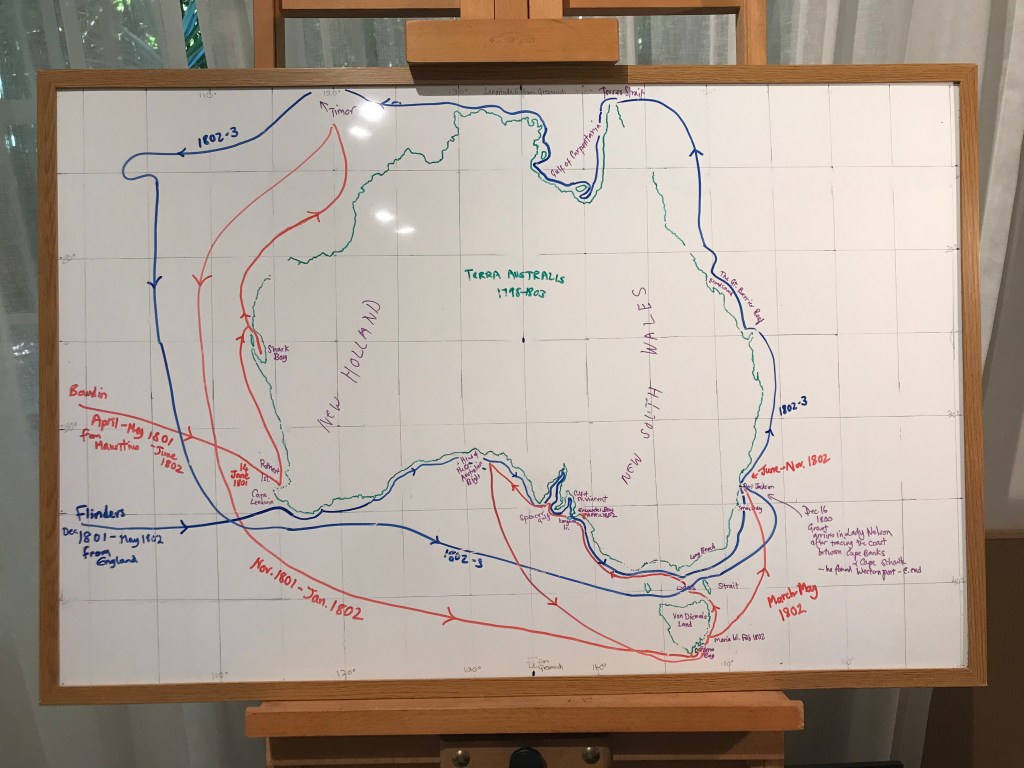
I’ve been able to chat to several specialists in the history of the early Australian navigators, who revealed so much more information that my head began to throb with the weight of it all. Danielle Clode is an inspiration – she adds creative imagination to all her histories, writes fiction as well, and is as versatile as some of the early scientist explorers, who couldn’t afford to be specialists when there were so many tasks involved in a voyage such as manning a ship, tending to the sick, mapping the coastline and recording discoveries. With the help of the State Library staff and local writer/historian Anthony Laube, who is a member of the May Gibbs Foundation Board, I discovered I was able to consult historical journals, view original engravings and purchase a giant copy of the French explorers’ map of Australia, which has helped me to picture the voyages much more clearly. However, I also needed to draw a map of my own in order to fully understand the timelines of the voyages, and the immensity of the undertaking that both explorers faced.

I still have to pay a visit to the Maritime Museum, where I will be able to dive more deeply into the challenges of shipboard life. I’ve already had a bit of a taste of this – I volunteered for a while on the One and All Sail Training Ship, and I spent two wonderful – and relatively sleepless – nights on Nightwatch on the Endeavour Replica, when she came to Port Adelaide in February 2016.
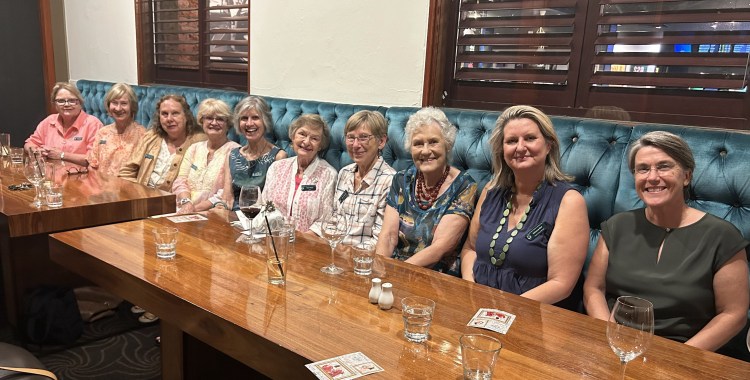
I’ve received plenty of TLC during this first sprint from the members of the May Gibbs Trust. I was welcomed by children’s author Elizabeth Hutchins, who has encouraged and mentored me in such a welcoming manner that I feel we’ve been friends all our lives. And last week, when I met nearly all the Trust members at a welcoming dinner, I felt I was part of one big family of book lovers and creatives.
My current task, the process of simplifying and streamlining history into a children’s novel, is just as challenging as including all the facts would be for a historian – and it will probably take just as long, but at least I’ve made a start! As for the story – you’ll have to wait until it’s finished!













 Julia Wakefield